
One in seven didn't have to break anything
In short
The Crime Statistics Agency's most recent published breakdown of how burglars enter Victorian homes covers the year ending December 2018. In it, a forced or broken door accounted for 23.6% of entry methods, and an unlocked or open door for 13.7% — roughly one break-in in seven where nothing had to be forced at all. Doors were the point of entry in 40.9% of residential burglaries, more than any other route. For the year ending 31 March 2026, released 18 June 2026, aggravated home burglaries across Victoria fell 19.9%, though they sit about 23% above where they were three years ago. The cheapest thing you can do about any of this costs nothing: lock the door behind you.
How do burglars actually get into Victorian homes?
Through the door, mostly.
The Crime Statistics Agency's burglary spotlight, covering the year ending December 2018, found doors were the entry point in 40.9% of residential burglaries — 15,139 offences. That is more than windows, more than garages, more than anything else.
Broken down by method, forcing or breaking a door was the single largest category at 23.6% of entry methods, or 7,526 offences. An unlocked or open door was second, at 13.7%, or 4,376 offences.
Is it true that most break-ins aren't forced?
No. That is a widely repeated claim and the published Victorian data does not support it.
On the Crime Statistics Agency's figures, forcing a door was close to twice as common as walking through an unlocked one. An earlier spotlight covering April 2014 to March 2015 pointed the same way: forced or broken doors at 26.5%, forced or broken windows at 18.3%, cut holes at 12.1%.
What is true — and it is the more useful fact — is that 13.7% is a very large number for a category where the burglar needed no tool, no skill and no noise. Roughly one residential burglary in seven. That is the part you control completely, and it costs nothing.
How old is this data, and does that matter?
It matters, and you should know it before you quote it.
The entry-method breakdown above is from the year ending December 2018, published by the Crime Statistics Agency in March 2019 and last updated in August 2024. It is the most recent published breakdown of its kind. The Agency's current quarterly data, for the year ending 31 March 2026, reports offence counts but not this level of entry-method detail publicly.
So the honest position is: the shape of the problem is well established and unlikely to have inverted, but nobody should present a 2018 percentage as a 2026 one. Anyone quoting you a precise current figure for unforced entry is making it up.
What actually reduces the risk?
In order, and with what each costs.
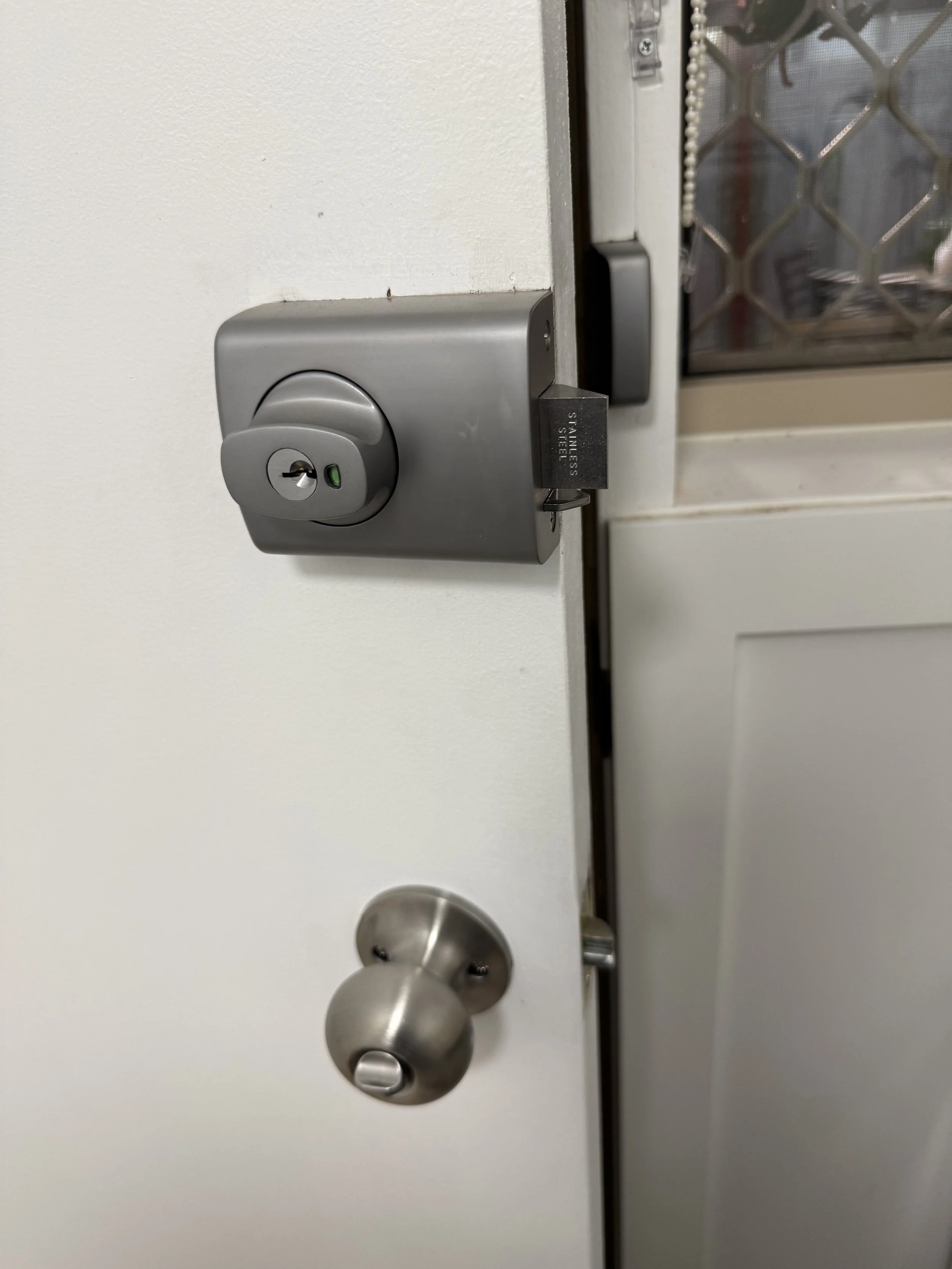
Lock the door. Free. It addresses the 13.7% directly and completely. We do not get paid for this one.
Put a real lock on the door that is worth forcing against. The doors that were forced were forced because forcing worked. A functioning deadlock on external entry doors is also a Victorian rental minimum standard, so for a rental this is not optional. A single security job starts at $195.
Get the property onto one key. People leave doors unlocked when locking is annoying. Rekeying is $60 for the first cylinder and $40 for each one after, and a house that locks with one key in your pocket gets locked more often than one that needs four.
Add a barrier in front of the door. A security screen door lets you keep the main door open in summer without the opening being usable. From $895, or $1,195 for Crime Tuff.
Cameras record, they do not hold a door shut. If the budget is small, the door comes first.
Does a deadlock actually stop someone getting in?
No. Anyone determined enough gets through a domestic door eventually, and we would rather say that than sell you a lock on a promise it cannot keep.
What a deadlock does is change the arithmetic. It turns a quiet three-second entry into a noisy two-minute one, in view of the street or a neighbour's kitchen window. Someone choosing between houses is choosing on time and visibility. That is the whole mechanism, and it is enough most of the time.
What it will not do is make a house impenetrable. Anyone selling you that is selling you the wrong thing, usually at the wrong price.
Free doorstep check — $0 We walk the property with you, tell you what we would do and in what order, and leave. No obligation, no commission from anyone. safehaus.com.au/doorstep-check
Sources
Spotlight: Burglary/Break and Enter Offences Recorded in Victoria, Crime Statistics Agency Victoria — entry points and entry methods for residential burglary, year ending December 2018. Published March 2019, last updated 20 August 2024.
Spotlight: Residential burglary, Crime Statistics Agency Victoria — the earlier entry-method breakdown, April 2014 to March 2015.
Release of Crime Statistics Agency data, year ending March 2026, Victoria Police — the 19.9% fall in aggravated home burglaries and the three-year comparison. Released 18 June 2026.
Latest Victorian crime data, Crime Statistics Agency Victoria — the current data period, year ending 31 March 2026.
Crime Statistics Agency data: 23.6% of residential burglaries were a forced door, 13.7% an unlocked one. What works, and what costs nothing.
