
Melbourne break-ins in 2026: what the latest numbers say — and what actually works
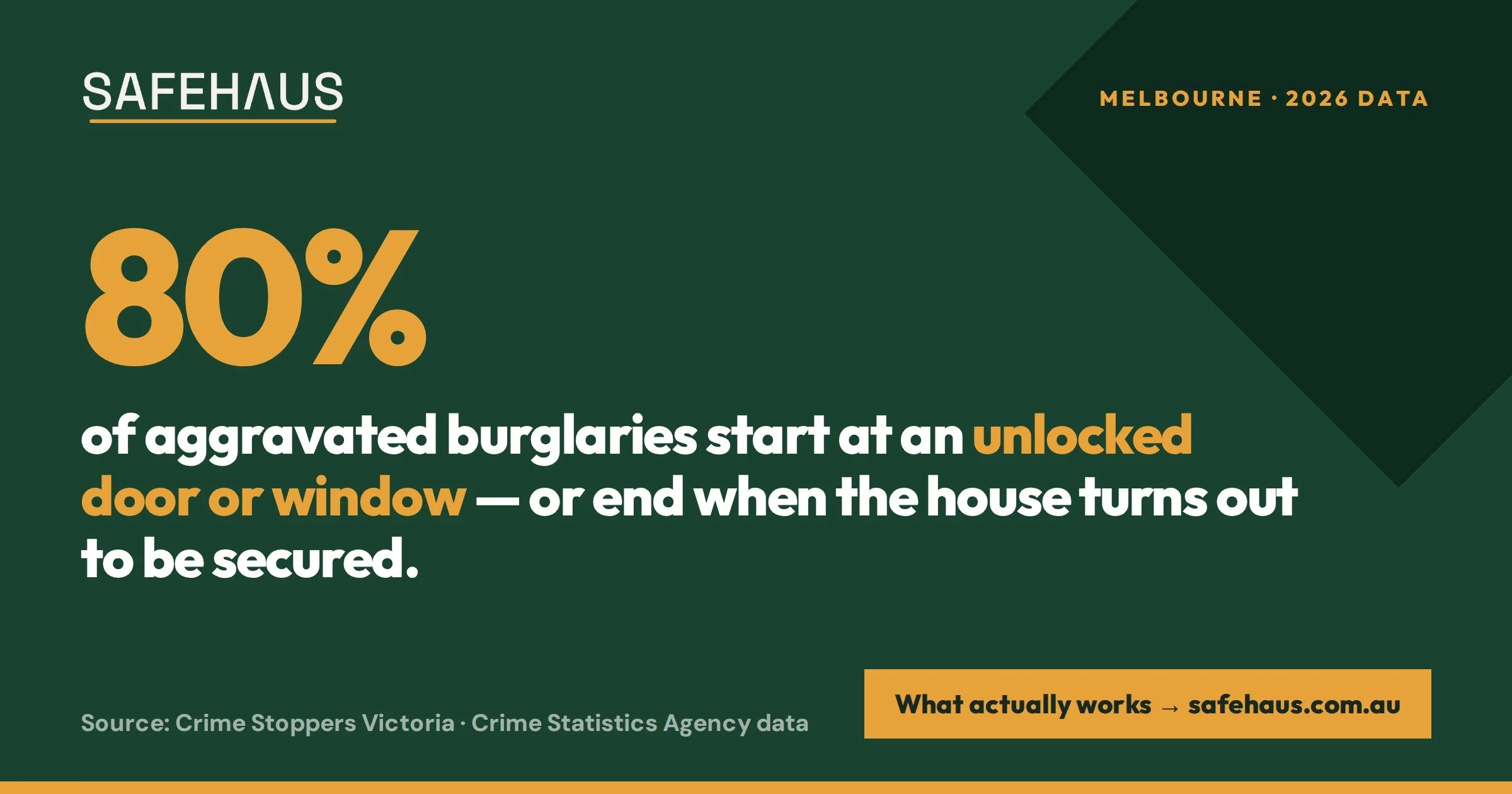
The short answer: the newest Victorian crime data shows most break-ins are crimes of opportunity, not skill. Around 80% of aggravated burglaries involve an unlocked door or window — or end when the offender finds the home secured. The most effective protection for a Melbourne home in 2026 isn't a subscription or a gadget: it's closing the physical gaps, starting with doors, then windows, then your car keys.
I run Safehaus, a Melbourne home security hardware business, and I spend my week looking at the same handful of weak points on different houses. Here's what the current data actually says — and where I'd put your money first. No scare campaign; just the numbers and an honest read of them.
What the 2026 data shows
The Crime Statistics Agency recorded around 27,900 burglaries of Victorian homes in the year to December 2025 — slightly down overall, which sounds like good news until you look inside the number. Aggravated burglaries — where offenders are armed or know someone is home — have hit record levels, and now make up a bigger share of the total than at any point in the last decade. Fewer than one in four burglaries is ever solved.
Three details in the data matter more than the headline:
Doors are the number-one entry point, followed by windows. Not roofs, not high-tech tricks — the front, back and sliding doors of ordinary houses.
About one in nine burglaries shows no sign of forced entry at all. The offender walked in. Crime Stoppers Victoria puts it more bluntly: up to 80% of aggravated burglaries involve entry through an unlocked door or window — or the attempt being abandoned once the home turns out to be secured. Their data also shows around 14% of home burglaries were failed attempts for exactly that reason: the house was locked.
Car keys are now the top target in aggravated burglaries, according to Victoria Police. Which brings us to the newest problem.
The new target: your car keys — and your car's computer
Victoria recorded 31,851 stolen cars in the year to March 2026 — the highest number since 2001-02, and more than double what it was four years ago. Police intelligence suggests up to 40% of cars are now stolen using key-mimicking or cloning technology that overrides the car's own security, and police have seized more than 1,100 of these devices since the start of 2025.
Victoria Police's own advice to owners now includes fitting an on-board diagnostic (OBD) port lock — a physical cover over the socket under your dash that thieves plug into to program a new key — along with parking off the street and locking everything. When the police force's stolen-vehicle advice names a specific piece of hardware, that's worth listening to. Signal-blocking pouches for your key fobs close the other route: the relay attack, where your key's signal is captured from inside the house and passed to the car in the driveway.
What I'd do first, in order
Lock the doors — properly. Sliding doors get a patio bolt so they can't be lifted off the track; entry doors get their strikes and hinges reinforced into the frame. This is the cheapest fix on the list and it addresses the number-one entry point.
Make every window lockable — then lock them. Keyed window locks and lockable winders mean a window can be open for air and still secured. One in nine break-ins with no forced entry is the statistic these solve.
Close the quiet route. The side gate and garage are how someone reaches the back of the house unseen. A drop bolt, a keyed latch and a garage that actually locks change the whole geometry of the property.
Fit the car hardware. OBD port lock, signal-blocking key shields, anti-theft plate screws. Twenty minutes of work against the fastest-growing theft category in the state.
Lock the meter box. An unlocked meter box lets anyone cut power to the house from the street. A clasp keyed to the Victorian Power Industry system keeps you and your distributor in, and everyone else out.
What I wouldn't spend on first
Honesty is cheaper than hardware, so: if your windows already have working keyed locks, a second lock on the same window adds nothing. A sensor light in a fully concealed side passage rarely helps — lighting deters by making someone visible, and it can't do that where nobody can see. And no product makes a home burglar-proof — anyone telling you otherwise is selling. The realistic goal, backed by the abandonment numbers above, is making your home the slower, louder, harder option — because that is demonstrably the point where most offenders give up or move on.
The honest bottom line
The 2026 data tells one consistent story: offenders are opportunists who test doors, reach through windows and hunt car keys — and a meaningful share of them simply leave when the basics are done. The basics are hardware, not subscriptions. Most of them cost less than one insurance excess.
Want to know where your home actually stands? Safehaus does a free 15-minute security check across Melbourne metro — a straight list of what's worth doing and what isn't, with fixed prices published before anything starts, from $295 fitted. If your place is already solid, we'll tell you that and shake your hand.
Safehaus supplies and installs physical property hardware at fixed prices. This article is general information drawn from published crime data — it is not a security assessment or advice on security equipment within the meaning of the Private Security Act 2004 (Vic). Sources: Crime Statistics Agency of Victoria; Victoria Police (March 2026 data release); Crime Stoppers Victoria; RACV.