
The 10-second test your sliding door will probably fail
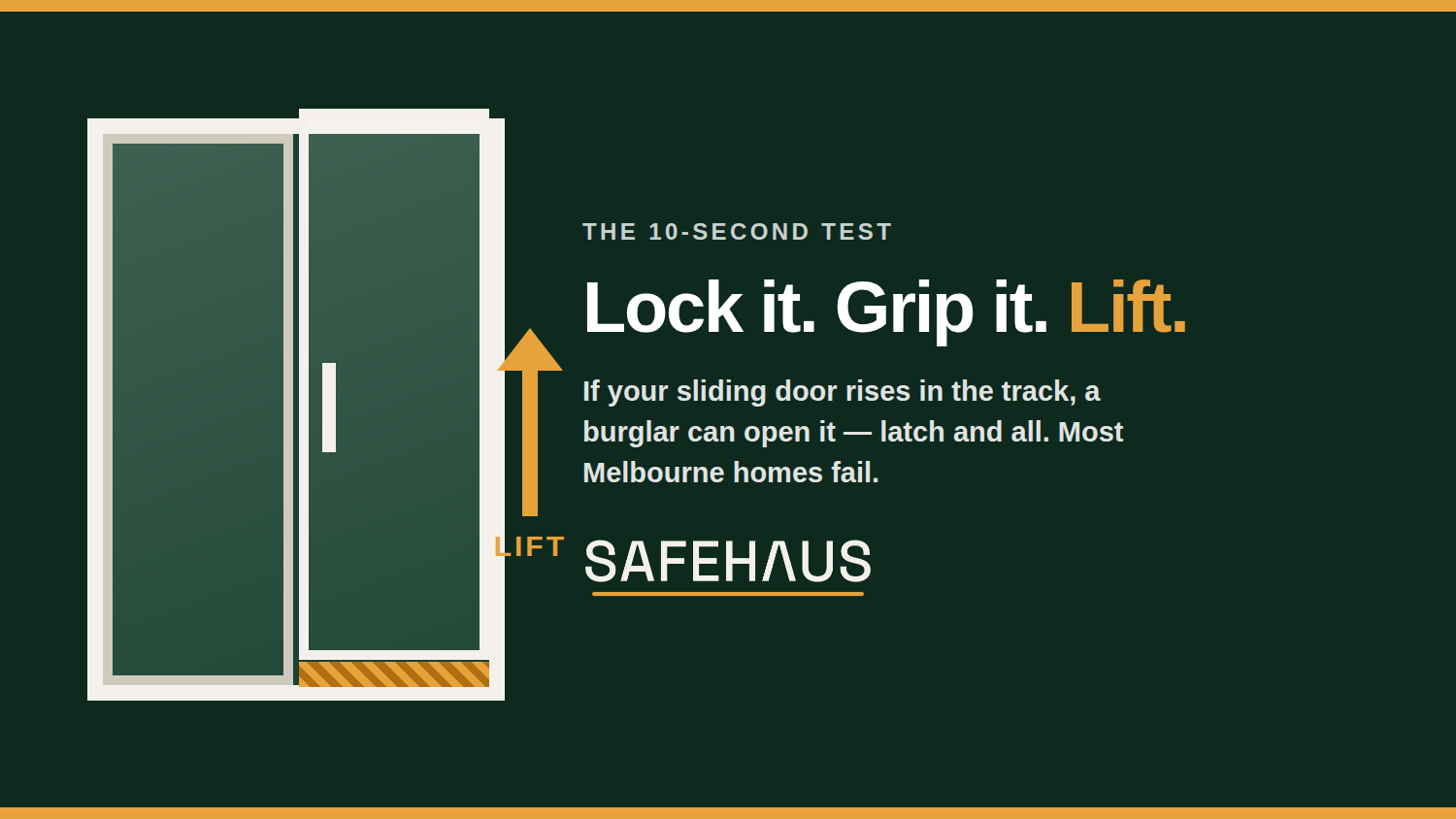
Walk to your back sliding door tonight. Lock it. Now grip the handle, lift the door upward, and pull. If it rises in the track — even a centimetre — you've just done what an intruder does, because on thousands of Melbourne homes that lift is all it takes: the door comes off its rollers or past its latch, and the "locked" back door opens without a sound. Sliding doors are consistently among the most common entry points named in Australian crime-prevention guidance, and the reason is exactly this: the factory latch was never a lock. It's a convenience catch.
Why are sliding doors the burglar's favourite entry?
Three reasons stack up. Position — they face the backyard, out of sight of the street, usually reached via a side gate that isn't locked. Construction — the door hangs on rollers in a track, held shut by a small aluminium latch designed to stop wind, not people; decades of Melbourne brick veneers from the 70s to the 90s carry the same hardware. Silence — a lifted or flicked sliding door makes no noise at all, which matters to someone who'd rather nobody wakes up. Add a flyscreen slider in front with a snib that can be reached through cut mesh, and the back of the average Melbourne home is two quiet moves from open.
How do intruders actually open a locked sliding door?
Four methods cover nearly all of it:
The lift — worn rollers and generous track clearance let the whole panel be lifted off its runners or above the latch keeper. Age and poor adjustment make it easier every year.
The latch flick — the factory catch can often be bounced or jiggled free; some give way to firm pressure alone.
The screen reach-through — mesh is cut or pushed near the snib on the outer screen door, a hand flicks it open, and the screen everyone relies on stops nothing.
The removed panel — on the worst-worn doors, the fixed or sliding panel can be walked out of the frame entirely.
None of these need tools worth mentioning, and none make noise.
What actually secures a sliding door? (Four fixes, no replacement)
You don't replace the door — you defeat each method with a piece of hardware:
Patio bolts (pair, top and bottom) — steel bolts that pin the sliding panel to the frame or track. This is the single fix: a bolted door can't be lifted or slid, whatever happens to the latch. The workhorse of every security visit we do.
Track bolt / anti-lift blocking — stops vertical movement in the track, killing the lift attack specifically; paired with patio bolts it closes the method entirely.
Sash jammers (pair) — swing-over secondary locks that make the door visibly dead even if the main latch is defeated. Cheap, obvious, and the visibility is half the point — intruders pick the house without them.
Screen-door snib shield — a clear plate over the screen's snib so no hand can reach through the mesh and flick it. A ten-minute fix for the classic screen defeat.
Every one is a surface-mount fit — no door replacement, no glazier — and all four together typically land inside our smallest fixed-price bundle. Renting? A track blocker or security bar drops into the rail with no drilling and comes with you when you move.
Frequently asked questions
Can I just put a broom handle in the track? It stops the slide — and does nothing about the lift, which is the method that defeats "locked" doors. It's better than nothing and far worse than a $30 bolt.
My sliding door is 30 years old — is it worth securing or should I replace it? Secure it. Hardware defeats the attack methods regardless of the door's age; replacement costs thousands and, without secondary locks, the new door ships with the same convenience catch.
Do sliding security screen doors solve this on their own? A proper security screen (steel mesh, triple-lock) is a genuine barrier — but its snib and lock still need to be unreachable, and the glass slider behind it still benefits from a bolt. Layers, not either/or.
What does all this cost? Patio bolts, sash jammers and a snib shield are all standard picks on our fixed-price menu — most sliding-door setups are fully hardened within a single bundle visit, alongside whatever else the check finds.
Start with the free check
If your door failed the lift test — or you'd rather not find out alone at 9pm — that's what the free 15-minute security check is for. We walk your home the way the person casing it would, sliding doors included, and give you a ranked fix-list with fixed prices on the spot. If your home's already solid, we'll tell you that too.
Sixty seconds to see where you stand first: safehaus.com.au/survey.
Book your free check at safehaus.com.au/homesecurity or call/text 0451 177 610.
Safehaus is a Melbourne-based, owner-operated home security service — police-checked, fully insured, fixed prices agreed before any work starts.